
热门搜索: 荡寇风云
神偷奶爸3
China’s Pinglu Canal linking Guangxi with ASEAN completes its first full-route patrol, paving way to September opening_我的网站

一 |
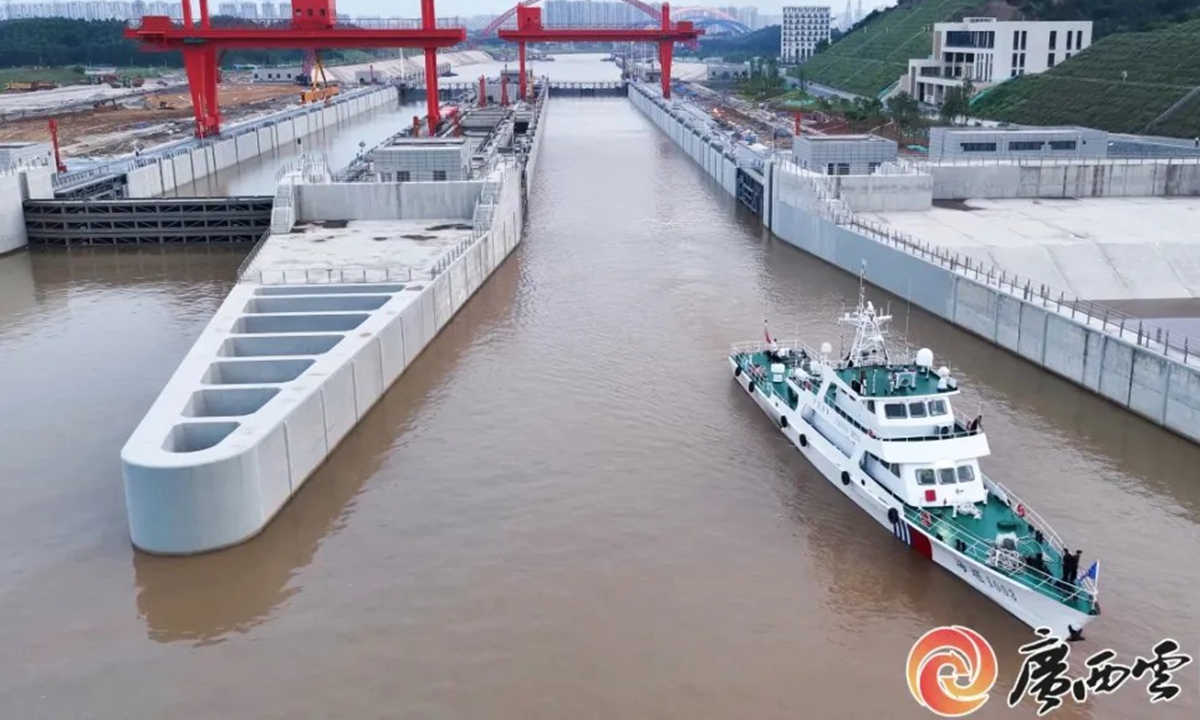
The inspection was carried out from Friday to Saturday by the Guangxi Maritime Safety Administration using the patrol vessel Haixun 1003.
Starting from the canal's seaward entrance, the vessel traveled northward along the entire waterway, passing through the Qingnian, Qishi and Madao ship locks, which remain under construction, while inspecting construction vessels operating along the route. It arrived at the Pingtang River estuary on the afternoon of Saturday.
It was the first time a vessel had completed the entire 134.2-kilometer journey following completion of the canal's main works, representing a breakthrough in full-route navigation tests using an actual vessel, according to Guangxi Daily.
The Haixun 1003 is the first offshore patrol vessel deployed by China's Ministry of Transport at Qinzhou Port. The vessel is 46.1 meters long and 6.8 meters wide, with a maximum speed of 25.3 knots and a cruising range of 500 nautical miles. It can withstand winds of up to Force 9 on the Beaufort scale, roughly 76-87 km/h usually with waves 6-9 meters.
The vessel is also equipped with an advanced marine electro-optical tracking and evidence-collection system capable of operating in color, monochrome, infrared and laser modes under different weather and lighting conditions. The system supports integrated data collection and transmission, Guangxi Daily reported.
During the patrol, maritime authorities conducted on-site inspections of key navigation conditions, including channel dimensions, curved sections of the waterway, navigational clearance beneath bridges, ship-lock approach channels and the mouths of tributaries.
The patrol was also designed to test the practicality of provisions contained in the Regulations on Navigation Safety Management of the Pinglu Canal, which are expected to take effect when the canal opens in September.
The results will provide a basis for refining vessel navigation rules and improving measures intended to safeguard traffic along the canal, according to the report.
Lü Jin, deputy director of the Qinzhou Maritime Safety Administration, said the inspection aims to assess the canal's navigational environment, verify whether navigational aids had been positioned appropriately, identify safety risks along the route and locate waters that could be used during emergencies.
The findings will also support the formulation of on-site supervision plans and help ensure that the canal opens safely and in an orderly manner on schedule, Lü said, according to Guangxi Daily.
The Pinglu Canal is a key project of the New International Land-Sea Trade Corridor. With total investment exceeding 70 billion yuan ($10.37 billion), the canal begins at the Pingtang River estuary in Hengzhou, administered by Nanning, follows the Qinjiang River into the Beibu Gulf, according to Xinhua News Agency.
It is China's first major river-to-sea canal project planned and coordinated at the national level since 1949 and is designed to accommodate vessels of up to 5,000 tons.
Once operational, the canal will give inland regions in Southwest China a more direct river route to the sea. Cargo that previously had to travel eastward through the Guangzhou port will be able to head south directly toward ports in the Beibu Gulf, shortening some inland waterway journeys by about 560 kilometers, according to Xinhua.
The New International Land-Sea Trade Corridor is an international trade and logistics network connecting China's western regions to ASEAN countries and other overseas markets.
It links the Silk Road Economic Belt in the north with the 21st Century Maritime Silk Road in the south while coordinating with the Yangtze River Economic Belt. China's National Development and Reform Commission released an overall plan for the corridor in 2019.
The corridor has continued to record strong trade growth. During the first half of 2026, imports and exports transported through the corridor by its participating regions reached 517.23 billion yuan, up 13 percent year-on-year and setting a new record for the same period, per data released by Chongqing municipal government.
The successful full-route patrol represents a crucial step in maritime authorities' preparations for the opening, providing data from actual vessel operations needed to improve navigation management, emergency planning and safety arrangements ahead of commercial operations, Guangxi Daily reported.
Global Times
。

二 | (ECNS) -- A university in southwest China is planning to allow students to bring pets to campus, sparking debate over how such a policy could affect campus life and animal management. Kunming City College in Yunnan Province announced the plan through its official WeChat account, with the post quickly attracting 29,000 views on social media. Under the plan, the college will establish pet-friendly dormitories where all roommates agree to keep pets, while a daytime care center will look after animals when students are in class. Most areas of the campus, with the exception of dining halls, will now be open to pets and will be equipped with water stations, fences and cleaning supplies. A dedicated pet health station will also provide free checkups and consultations, maintain health records and will test whether the pets are vaccinated each semester. Cats and dogs will be allowed, along with small animals such as rabbits and hamsters and exotic pets permitted under Chinese law. However, dog breeds banned in the city, as well as animals considered aggressive or potentially harmful to human health, will not be permitted. The proposal has received support from students. Those who normally spend months away from their pets would be able to keep them nearby, helping ease homesickness while also providing the animals with more consistent care. However, the plan has also raised concerns, particularly over allergies, fear of animals and the challenges of keeping pets in shared dormitories, including noise, waste and the risk of bites or fights. In response, the college said the proposal was based on years of experience rather than a spur-of-the-moment decision. The university has long provided shelter for stray animals on campus and this year established a school of pet science and technology, offering programs in areas including pet medicine, care and training. Before the policy takes effect, the university will conduct further research and take individual circumstances into consideration, with detailed rules expected to be introduced later this year. The move comes as more schools in China experiment with pet-friendly policies. In 2023, Nanning No. 2 High School in Guangxi Zhuang Autonomous Region allowed students to keep one pet per class as part of a student-led initiative aimed at easing academic pressure and helping students become more responsible. At least eight Chinese universities have launched pilot programs allowing students to bring pets to campus, with most targeting students entering university in 2026 and giving priority to those studying pet-related majors. (By Helen Mo & intern Liu Shuangjing) 
 。
。
Current article:http://8a2k4up.ningshunsaotuiqiao.shop/lbwg/20260826/4451.xls
Published on:07:51:11
栏目相关
- 预售价10.58万元起 零跑B01正式开启预售
- 【仓单】8月26日郑商所菜粕期货仓单较上一日下降1980张
- 外贸稳健开局 新设外企数量增长逾两成
- 克莱正式落户迈阿密 再穿上勇士时代标志性号码
- 技嘉预热更多 AORUS ARI“雕妹”主题硬件,暗示新显卡、机箱、电源
- 美对华撤销芯片出口,中国减持448亿美元外汇
- 县市场监督管理局:跨区域执法督查药品安全
- 辽宁振兴大讲堂暨抚顺振兴讲坛开讲
- 蓝天救援队开展消防安全知识讲座
- Is the rapid growth of China’s emerging industries driven by industrial subsidies?: People’s Daily
- 马斯克警告做空 SpaceX 的机构:存活概率极低
- Man killed Muslim boy and wounded woman in hate crime motivated by Israeli-Hamas war, police say
热门排行
- 【现货】8月26日环渤海动力煤港口价格汇总:秦皇岛环渤海动力煤(5500K)报价715元/吨
- 다양한 반도체 관련 전시물 살펴보는 관람객들
- 二手PS5 Pro竟卖到6899!全新机器更加离谱
- 河南新乡通报:母子被同学家长殴打 打人者被行拘
- China-Europe freight trains deliver over 34,000 cooling appliances
- APEC host city Shenzhen offers glimpse of China's future industries
- 加快让綦江“千里轻舟”通江达海的愿景成真
- 《泉州市传承弘扬创新发展“晋江经验”条例》8月20日起施行
- 上半年经济增长4.7%说明了什么?,上半年经济增长4.7%说明了什么?
- Kareena Kapoor Khan and Sons Taimur & Jeh Meet Lionel Messi in Mumbai
- 宝马董事长称不应设定汽油车淘汰日期
- 鲁内胜阿卡夺500首冠,奥胖与萨巴争保时捷,郑钦文又抽到苦主